Do Veneers Damage Your Teeth?

Updated July 2026
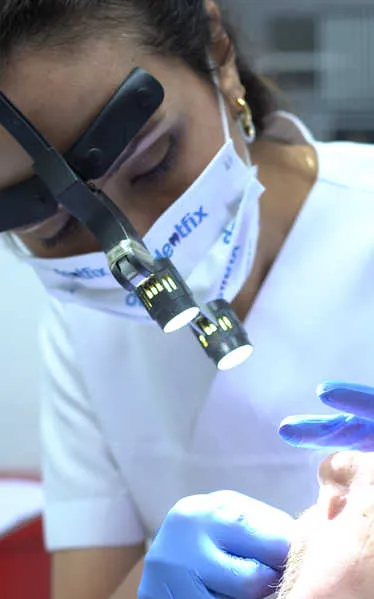
The short answer: properly planned porcelain veneers do not damage your teeth — modern preparation removes only about 0.3–0.7 mm of enamel, roughly the thickness of a fingernail, and the bonded porcelain then protects the surface underneath. But honesty matters: veneers are not reversible, and in the wrong hands or the wrong case they absolutely can harm teeth. The difference is diagnosis and restraint.
What actually happens to the tooth
A veneer covers only the front surface and edge of the tooth. To make room for it without bulky results, a thin layer of enamel is reshaped — 0.3 to 0.7 mm depending on tooth position and alignment. In some cases ("no-prep" or additive cases) almost nothing is removed at all. The veneer is then chemically bonded, sealing the prepared surface completely.
Where the damage myth comes from
- Crowns sold as veneers: some volume clinics grind teeth into pegs for full crowns and call it a "Hollywood smile veneer package". That IS destructive — and it is not veneer treatment.
- Over-preparation: removing dentin (below the enamel) weakens bonding and can cause sensitivity. Careful case selection avoids it.
- Skipping diagnosis: putting veneers over untreated decay or gum disease seals a problem inside — the failure is then blamed on "veneers".
The honest part: irreversibility
Once enamel is reshaped, the tooth will always need a veneer (or crown) on it. That is exactly why Dr. Atay screens whether a more conservative route — whitening, bonding, orthodontic alignment — would achieve your goal first. A prosthodontist has all of those tools; a veneer-only clinic has a hammer, and everything looks like a nail.
When veneers are the wrong choice
- Teeth that mainly need colour improvement → professional whitening first, always.
- Significant misalignment → aligners can move teeth, then fewer or thinner veneers (or none) are needed.
- Heavy untreated grinding → the cause must be managed first, or any restoration will fail.
- Active decay or gum disease → health always precedes cosmetics.
How to protect yourself as a patient
Ask two questions in any consultation: "How much of my enamel will remain?" and "What would you do if I were your family member?" A specialist will show you the preparation plan tooth by tooth on your scan — before anything touches your teeth. In Dr. Atay's digital smile design workflow, you approve a physical trial smile first, so the decision to prepare is made with full information.
Find out what your teeth actually need
Send photos on WhatsApp — if whitening or alignment would serve you better than veneers, Dr. Atay's team will tell you exactly that.
WhatsApp Consultation Veneers & Smile Design →Frequently asked questions
Do veneers ruin your natural teeth?
No — modern veneer preparation removes only 0.3–0.7 mm of enamel and the bonded porcelain protects the tooth. Damage happens when crowns are disguised as veneers or when disease is ignored underneath.
Are veneers reversible?
No. Reshaped enamel does not grow back, so the tooth will always need a veneer or crown. This is why proper case selection matters so much.
Do teeth rot under veneers?
A correctly bonded veneer seals the surface; decay under veneers is almost always at neglected margins — preventable with normal brushing, flossing and check-ups.
Is there pain or sensitivity after veneers?
Mild sensitivity for a few days is possible and normal. Persistent sensitivity usually indicates over-preparation into dentin — which careful, minimal technique avoids.
Can I get veneers without any shaving?
In selected cases yes — additive or "no-prep" veneers work when teeth are small, inward-positioned or worn. A scan shows whether you qualify.