Full-Mouth Rehabilitation: The Complete Guide

Updated July 2026
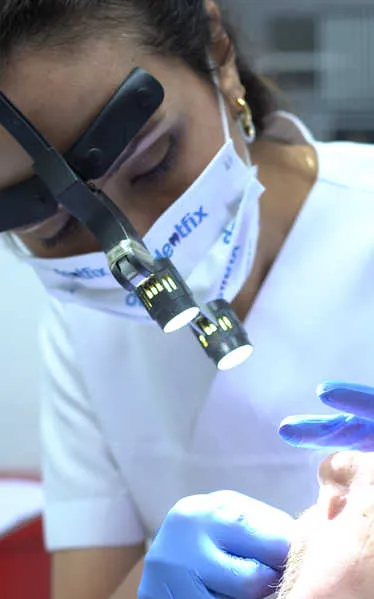
The short answer: full-mouth rehabilitation rebuilds all the teeth that are worn, broken, failing or missing — in both jaws, as one coordinated plan. It combines crowns, veneers, onlays and implants as needed, and, crucially, it re-establishes the bite itself: the height at which your teeth meet, the contacts between them, and the way your jaw closes. That is what separates it from a cosmetic smile makeover — and it is the core territory of a prosthodontist.
What counts as full-mouth rehabilitation?
The name is literal: rather than fixing one tooth at a time as problems appear, the whole mouth is diagnosed and rebuilt to a single, coherent end point. That typically includes treating decay and gum problems first, replacing old restorations that are failing, restoring worn or broken teeth, replacing missing teeth, and setting a new, stable bite for everything to meet in. Aesthetics is part of the plan — the front teeth are designed with the same care as in any smile design — but function leads.
Signs you may need more than a smile makeover
- Your teeth look shorter than they used to, or the edges are flat, chipped or translucent.
- You grind or clench, and you can see the results — wear facets, cracks, flattened tips.
- Many large fillings, root canals or old crowns are failing one after another.
- Your bite feels collapsed: the lower face looks shorter, the chin closer to the nose, the corners of the mouth fold.
- You have a combination of missing teeth and damaged teeth — so replacing one gap would not solve the whole picture.
- Jaw muscles tire easily, or chewing has quietly migrated to the few teeth that still work.
Rebuilding the bite, not just the teeth
This is the step that makes full-mouth work a specialist discipline. When teeth wear down over decades, the jaw adapts — muscles shorten their path, joints settle into a compensated position. Simply gluing longer teeth onto that situation invites trouble. Instead, the new bite height is planned from records and analysis, then test-driven in provisionals: temporary teeth built to the proposed new dimension that you chew, speak and live with before anything is final. Only when the trial position proves comfortable is it copied into the definitive ceramics. Adjusting a provisional is trivial; adjusting a finished arch of porcelain is not — which is why the rehearsal matters.
The building blocks — and how they combine
No single treatment rebuilds a whole mouth. A rehabilitation plan assigns the most conservative suitable tool to each tooth:
| Problem | Typical building block |
|---|---|
| Worn, shortened or broken teeth | Crowns or onlays to rebuild height and protect what remains |
| Intact but discoloured or misshapen front teeth | Veneers with minimal preparation |
| Single missing teeth | Implants with individual crowns |
| Several or all teeth missing | Implant bridges or full-arch solutions such as All-on-4 |
| Collapsed bite height | Vertical dimension restored across all teeth together |
| Old failing crowns and fillings | Replaced and integrated into the new bite |
Material choices follow the same logic — stronger ceramics such as zirconia where forces are high, more translucent ceramics where light matters most. The result should read as one smile, not a collection of repairs.
How treatment is staged over visits
For international patients, the plan is organised around travel:
- Records and planning: photos, digital scans, X-rays or CBCT, bite records — often reviewed remotely before you fly, then confirmed chairside.
- Digital design and mock-up: the new tooth positions and bite are designed digitally and, where useful, shown in your mouth as a trial layer.
- Preparation and provisionals: teeth are prepared and provisional teeth set to the new bite — the test-drive phase.
- Definitive ceramics: the final crowns, veneers and bridges are fitted, checked and refined.
Cases without implants are often completed in a single Istanbul visit of roughly 5–10 working days. When implants are part of the plan, treatment typically spans two visits 3–6 months apart: implants placed and provisionals worn while the bone heals, definitive teeth on the second visit. Complex cases are sometimes phased jaw by jaw. The full treatment scope is described on our full-mouth rehabilitation page.
Why prosthodontist-led planning matters
Full-mouth rehabilitation is, quite literally, what prosthodontics is for: it is the dental specialty devoted to restoring and replacing teeth and rebuilding occlusion. As a prosthodontist with a PhD from Ege University, an associate professorship at Altınbaş University and more than twenty years of clinical work, Dr. Atay plans these cases end-to-end — one clinician responsible for the diagnosis, the bite concept, the material choices and the final result, rather than a chain of hand-offs. For a treatment where every tooth must agree with every other tooth, that single point of responsibility is not a luxury; it is the method.
Full-mouth rehabilitation in Istanbul
Istanbul has become one of the busiest destinations for this kind of comprehensive dentistry, and the practical case for it is straightforward: treatment costs typically run 60–70% below Western European levels for the same brand materials, and the compressed visit format suits a treatment that needs many appointments in sequence. The same caution applies here as anywhere — comprehensive work deserves a named, credentialed clinician, an itemised plan, and honest staging rather than a race against your return flight.
Wondering what your mouth actually needs?
Send a few photos and describe what bothers you — Dr. Atay's team will tell you honestly whether you need single treatments or a coordinated rehabilitation plan.
WhatsApp Consultation Full-Mouth Rehabilitation →Frequently asked questions
What is the difference between a smile makeover and full-mouth rehabilitation?
A smile makeover is primarily aesthetic and usually focuses on the visible front teeth. Full-mouth rehabilitation treats function and health as well as appearance: it rebuilds the bite, replaces failing dental work and restores every tooth that needs it — in both jaws.
How long does full-mouth rehabilitation take?
Cases without implants are often completed in a single visit of roughly 5–10 working days. When implants are involved, treatment is typically staged over two visits 3–6 months apart so the implants can heal before the final teeth are fitted.
Will the new bite feel strange at first?
A period of adaptation is normal — you usually test the new bite in provisional teeth first, so the final ceramics reproduce a position your muscles and joints have already accepted. Small adjustments are part of the process, not a sign that something went wrong.
Do all my teeth need crowns?
No. Good planning uses the most conservative option each tooth allows: veneers or onlays where enough healthy structure remains, crowns where teeth are heavily damaged, implants only where teeth are missing or cannot be saved.
How long do the results last?
Modern ceramics typically last 10–15 years or longer with good hygiene, regular check-ups and — for grinders — a night guard. Longevity depends more on maintenance and bite protection than on the materials alone. Individual results vary.